
HVAC & Systems Engineering Critical Infrastructure Accelerator
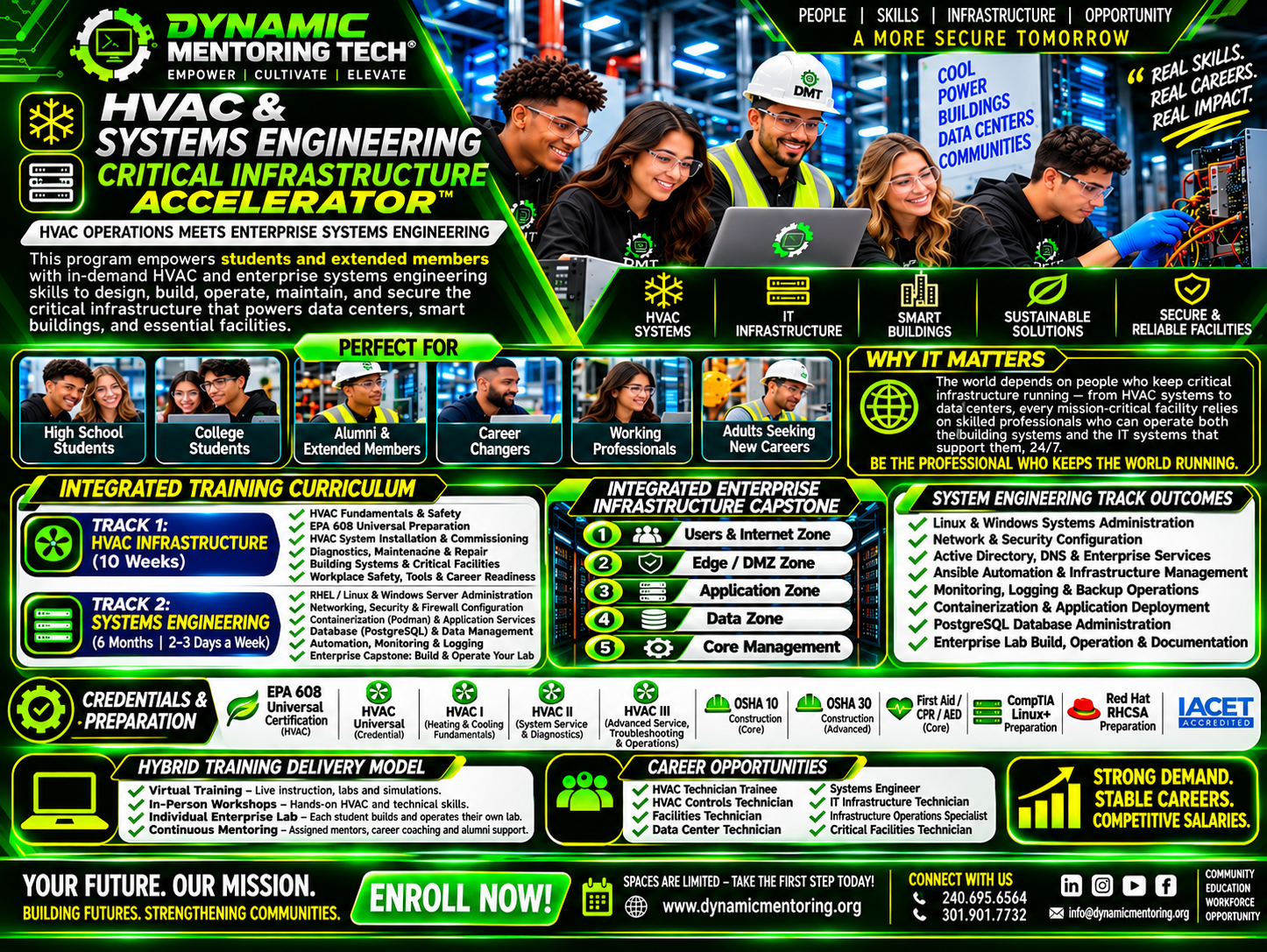
HVAC & Systems Engineering Critical Infrastructure Accelerator™
DMT NextGen Trade MAX™ | Integrated Workforce Development Program
Two Career Tracks. One Powerful Workforce Accelerator.
HVAC Operations Meets Enterprise Systems Engineering.
Training Ends. Mentoring Never Stops.
Building the Next Generation of Critical Infrastructure Professionals
At Dynamic Mentoring Tech (DMT), we are transforming workforce development by bringing together two essential industries—Heating, Ventilation, Air Conditioning & Refrigeration (HVAC/R) and Enterprise Systems Engineering—into one integrated career training experience.
Modern infrastructure depends on more than technology alone. Data centers, hospitals, smart buildings, commercial facilities, and mission-critical environments require professionals who understand the mechanical systems that maintain safe operating conditions and the enterprise technologies that support, monitor, automate, and secure those environments.
The DMT HVAC & Systems Engineering Critical Infrastructure Accelerator™ is designed to prepare students for opportunities at the intersection of skilled trades and information technology.
Our innovative workforce development model combines HVAC technical education, industry credential preparation, Linux and Windows systems administration, enterprise networking, automation, infrastructure security, and hands-on technical labs.
Through virtual instructor-led training, supervised in-person workshops, individual enterprise infrastructure projects, and assigned technical mentoring, students gain practical skills applicable to today’s rapidly evolving critical infrastructure workforce.
Our mission is simple: Equip students with real technical skills, meaningful credentials, and career pathways that support the infrastructure of tomorrow.
One Integrated Program. Two Specialized Career Tracks.
Track 1: HVAC Infrastructure & Critical Facilities
10-Week HVAC Training Program
The HVAC Infrastructure track introduces students to the fundamental principles of heating, ventilation, air conditioning, and refrigeration, with an emphasis on the systems supporting residential, commercial, and critical facility environments.
Students develop knowledge and practical skills in:
- HVAC fundamentals, components, and system operation
- Refrigeration principles and electrical safety
- HVAC installation, maintenance, and repair
- System diagnostics and troubleshooting
- Heating and cooling controls
- HVAC equipment used in commercial buildings and data centers
- Workplace safety, tools, and technical documentation
HVAC Credential Pathway
Students receive preparation for the following credentials:
- EPA Section 608 Universal Certification
- HVAC Universal
- HVAC I — Heating & Cooling Fundamentals
- HVAC II — System Service & Diagnostics
- HVAC III — Advanced Service, Troubleshooting & Operations
These credentials and training milestones are intended to help students build progressive HVAC knowledge, from foundational principles to more advanced technical applications. Actual credential awards depend on the applicable issuing organization’s assessment requirements.
The HVAC track also provides a foundation for students interested in advancing into commercial HVAC, building automation, data center cooling, and critical facilities maintenance.
Track 2: Enterprise Systems Engineering
6-Month Systems Engineering Program | 2–3 Days Per Week
The Enterprise Systems Engineering track prepares students to build, configure, administer, automate, and secure the computing environments used throughout modern organizations.
Students develop practical skills in:
- Red Hat Enterprise Linux (RHEL) administration
- Windows Server administration
- Enterprise networking and security configuration
- Active Directory, DNS, and enterprise services
- Podman containers and application deployment
- PostgreSQL database administration
- Ansible automation and infrastructure management
- System monitoring, logging, backup, and recovery
- Enterprise security hardening and operational troubleshooting
Students also receive preparation aligned with CompTIA Linux+ and Red Hat Certified System Administrator (RHCSA) certification objectives.
The goal is to develop technical competencies that support entry-level infrastructure administration, systems operations, and advanced technical career pathways.
The DMT Integrated Enterprise Infrastructure Capstone
Don’t Just Study Enterprise Systems. Build Your Own.
A defining component of this accelerator is the DMT Enterprise Infrastructure Lab, where students build, configure, secure, automate, and operate their own simulated enterprise computing environment.
Each student develops a five-zone infrastructure architecture:
Zone 1 — Users & Internet: Client systems, internet connectivity, streaming applications, and AI assistant integration.
Zone 2 — Edge / DMZ: Enterprise routing, firewalls, network address translation, load balancing, and controlled external access.
Zone 3 — Application: RHEL application servers, Podman containers, application services, and AI-enabled infrastructure.
Zone 4 — Data: PostgreSQL database systems, replication, shared storage, and data recovery.
Zone 5 — Core Infrastructure Management: Windows Server, Active Directory, DNS, Ansible automation, monitoring, logging, backup, and security management.
The capstone allows students to demonstrate real technical competencies through a completed infrastructure project and supporting documentation.
Connecting HVAC to Enterprise Technology
The integrated accelerator also introduces students to how HVAC and enterprise technology support one another in modern critical facilities.
Students explore concepts such as building management systems (BMS), HVAC monitoring, environmental sensors, operational alerts, and infrastructure availability.
For example, students may examine simulated data center cooling alerts and learn how enterprise monitoring systems can identify environmental conditions that could affect critical computing equipment.
This connection helps students understand the relationship between physical building operations and the technology infrastructure those facilities support.
Flexible Hybrid Training Designed for Working Adults
DMT’s training model combines virtual education with practical hands-on experiences.
Virtual Instructor-Led Training: Participate in live technical instruction, interactive learning, and guided lab exercises.
In-Person HVAC Workshops: Develop practical skills through supervised demonstrations, equipment familiarization, troubleshooting, and competency assessments.
Individual Enterprise Infrastructure Labs: Build and manage a complete enterprise computing environment.
Continuous Technical Mentoring: Receive support from assigned mentors, technical instructors, and career development resources.
Our hybrid approach is designed to support students balancing education with work, family responsibilities, and other commitments.
Industry Credentials & Career Preparation
DMT’s integrated program combines HVAC credential preparation, construction safety education, and enterprise technology certification pathways.
Students may pursue applicable credentials and training, including:
- EPA Section 608 Universal Certification
- HVAC Universal, HVAC I, HVAC II, and HVAC III
- OSHA 10-Hour Construction
- OSHA 30-Hour Construction — Advanced Option
- First Aid / CPR / AED
- CompTIA Linux+ Certification
- Red Hat Certified System Administrator (RHCSA)
Training incorporates industry-aligned curriculum, technical assessments, practical labs, and career preparation. Credential issuance and examination eligibility remain subject to the requirements of the relevant providers.
Career Opportunities Across Multiple Industries
The combination of HVAC and enterprise systems engineering introduces students to career pathways in skilled trades, information technology, building operations, and critical infrastructure.
HVAC & Critical Facilities Careers
- HVAC Technician Trainee
- HVAC Controls Technician Trainee
- Commercial HVAC Maintenance Technician Trainee
- Critical Facilities Technician Trainee
- Data Center Cooling Technician Trainee
Enterprise Systems & Infrastructure Careers
- Junior Linux Systems Administrator
- Junior Windows Systems Administrator
- IT Infrastructure Technician
- Data Center Technician
- Infrastructure Operations Technician
- Systems Monitoring Technician
With additional experience, qualifications, and specialized training, graduates may progress toward more advanced HVAC, building automation, systems engineering, and critical infrastructure positions.
Why Choose Dynamic Mentoring Tech?
Training Ends. Mentoring Never Stops.
At DMT, workforce development is more than completing courses or passing certification examinations.
We believe successful career development requires technical competency, hands-on experience, professional mentorship, and continued opportunities to learn and grow.
Our integrated training model emphasizes:
- Real Skills: Practical instruction using relevant HVAC and enterprise technologies.
- Real Experience: Hands-on workshops, virtual simulations, and individual infrastructure labs.
- Real Credentials: Preparation for recognized industry certifications and professional development milestones.
- Real Mentorship: Assigned technical mentors and ongoing career coaching.
- Real Opportunities: Career preparation and pathways into skilled trades, IT, and critical infrastructure operations.
DMT is committed to helping students develop the skills and confidence to pursue meaningful careers while strengthening the communities and industries they serve.
Program at a Glance
Program: HVAC & Systems Engineering Critical Infrastructure Accelerator™
HVAC Training: 10 Weeks
Systems Engineering Training: 6 Months
Delivery: Hybrid — Virtual Training + In-Person Workshops
Enterprise Capstone: Individual Five-Zone Enterprise Infrastructure Lab
Career Focus: HVAC, Data Centers, Building Operations, Enterprise Systems, and Critical Infrastructure
Student Support: Technical Mentoring + Career Coaching
Credential Preparation: EPA 608 Universal, HVAC I–III, OSHA, CompTIA Linux+, and RHCSA
Your Future. Our Mission.
Building Futures. Strengthening Communities.
The infrastructure of tomorrow will require professionals who understand both the physical systems that keep facilities operating and the enterprise technologies that connect, monitor, and support them.
At Dynamic Mentoring Tech, we’re preparing students to meet that challenge.
Whether you’re a high school graduate, college student, career changer, working professional, or adult seeking new opportunities, the HVAC & Systems Engineering Critical Infrastructure Accelerator™ provides a structured pathway to develop technical skills across two complementary disciplines.
Real Skills. Real Careers. Real Impact.
Enroll Today — Start Building Your Future
Dynamic Mentoring Tech (DMT)
Website: https://dynamicmentoring.org
Email: info@dynamicmentoring.org
Phone: 240-695-6564
Empower. Cultivate. Elevate.