
Cloud Database Engineer Accelerator
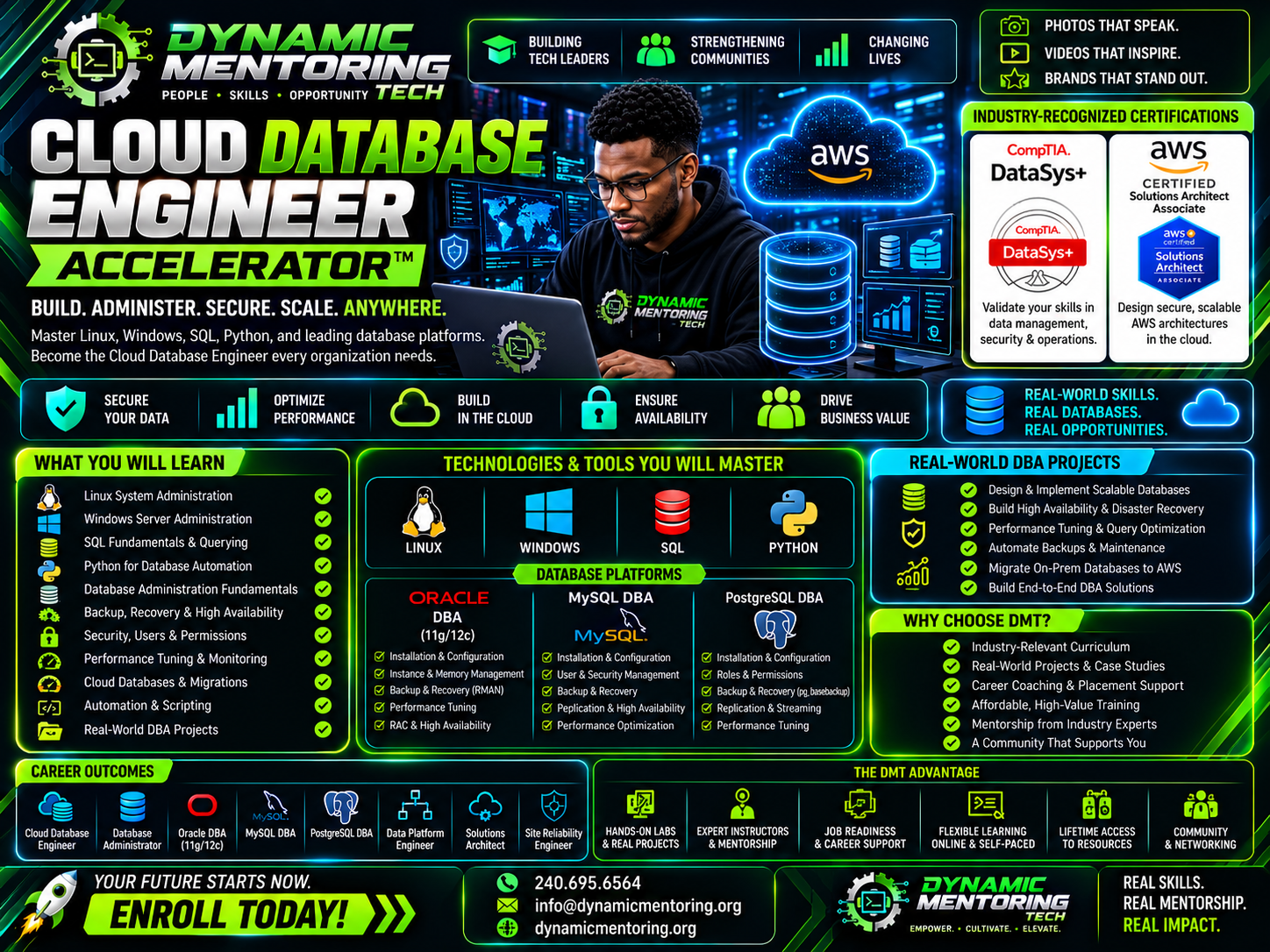
DMT Cloud Database Engineer Accelerator™
Build. Administer. Secure. Scale. Anywhere.
From Database Administration Foundations to Enterprise Cloud Database Engineering
Don’t just learn databases. Learn to design, deploy, secure, automate, and manage the data infrastructure that powers modern enterprises!
At Dynamic Mentoring Tech (DMT), we’re preparing the next generation of Cloud Database Engineers through hands-on technical training, expert mentorship, industry-recognized certification preparation, and real-world database engineering projects.
Our DMT Cloud Database Engineer Accelerator™ is a comprehensive, career-focused workforce development program designed to equip aspiring database professionals with the technical skills, practical experience, and engineering mindset needed to support today’s data-driven organizations.
From Linux and Windows systems administration to SQL, Python automation, enterprise database platforms, and AWS cloud infrastructure, students develop the skills necessary to build, administer, secure, optimize, and scale mission-critical database environments.
Whether you’re a high school graduate, college student, career changer, aspiring IT professional, or experienced technician looking to advance your career, this program provides a structured pathway into enterprise database administration and cloud database engineering.
Four Technical Foundations. Three Enterprise Database Platforms. One Career Accelerator.
Our curriculum combines essential infrastructure technologies with specialized database administration training to help students understand how enterprise databases operate across traditional datacenters, hybrid environments, and cloud platforms.
Foundation 1 — Linux System Administration
Develop the Linux administration skills required to deploy, manage, troubleshoot, and secure enterprise database servers.
Students learn command-line administration, user and group management, file permissions, networking, storage, system services, security hardening, and Bash scripting.
Foundation 2 — Windows Server Administration
Build practical experience administering Windows Server environments that support enterprise applications and database infrastructure.
Training includes Windows administration, user management, Active Directory fundamentals, PowerShell, networking, system security, event logging, and monitoring.
Foundation 3 — SQL Fundamentals & Database Querying
Master the language used to access, manage, and analyze relational databases.
Students develop skills in SQL queries, joins, filtering, aggregation, data manipulation, database objects, indexing, and performance fundamentals.
Foundation 4 — Python for Database Automation
Learn to automate database administration and operational workflows using Python.
Training covers Python fundamentals, scripting, database connectivity, APIs, file handling, automation, and practical database management tasks.
Enterprise Database Administration Specializations
Students gain exposure to three widely used enterprise relational database platforms.
Oracle Database Administration (11g/12c)
Develop foundational and intermediate Oracle DBA skills, including database installation, configuration, instance management, backup and recovery using RMAN, performance monitoring, and high-availability concepts.
MySQL Database Administration
Learn to install, configure, secure, maintain, and optimize MySQL database environments.
Students explore user management, database backups, replication, high availability, performance tuning, and troubleshooting.
PostgreSQL Database Administration
Develop hands-on skills with PostgreSQL, including database installation, role-based permissions, backup and recovery, replication, streaming, monitoring, and performance optimization.
AWS Cloud Database Engineering
Students extend their database administration knowledge into cloud infrastructure and database services.
Training introduces AWS architecture and database technologies, including Amazon RDS, Amazon EC2, Amazon VPC, Amazon S3, AWS Identity and Access Management (IAM), monitoring, backup strategies, and cloud migration concepts.
Students learn how database infrastructure is designed, secured, and operated in AWS environments while considering scalability, availability, performance, and cost optimization.
Industry-Recognized Certification Preparation
The DMT Cloud Database Engineer Accelerator includes training aligned with two industry-recognized certifications:
CompTIA DataSys+
Build and validate essential knowledge of database administration, database deployment, security, data management, maintenance, and business continuity.
AWS Certified Solutions Architect – Associate
Develop the knowledge required to design secure, resilient, high-performing, and cost-optimized cloud architectures on AWS.
These certifications complement the program’s hands-on database administration and cloud engineering projects. Certification credentials are awarded by their respective providers after successful examination.
What Will You Build? Real-World Database Engineering Projects.
At DMT, students don’t just learn database commands. They build and operate the systems that enterprise applications depend on.
Throughout the program, students complete practical labs and engineering projects that simulate real-world database administration responsibilities.
Student Project Deliverables
1. Enterprise Database Server Deployment
Install and configure Linux and Windows servers to support enterprise database workloads.
2. Relational Database Implementation
Deploy and administer Oracle, MySQL, and PostgreSQL database environments, including database objects, users, permissions, and access controls.
3. Database Security & Access Management
Implement role-based permissions, database authentication, secure connectivity, auditing, and foundational data protection controls.
4. Backup, Recovery & Disaster Recovery
Configure database backup procedures, perform restoration exercises, and document recovery strategies.
5. High Availability & Database Replication
Build and test database replication configurations and explore high-availability architecture and failover concepts.
6. Database Performance Optimization
Analyze SQL queries, review execution plans, implement indexes, monitor database resources, and troubleshoot performance bottlenecks.
7. Python Database Automation
Develop Python scripts to automate database maintenance, reporting, health checks, and selected administrative tasks.
8. AWS Cloud Database Deployment & Migration
Deploy cloud-based database environments, configure networking and security controls, and practice migrating database workloads into AWS.
9. Enterprise Cloud Database Engineering Capstone
Design, deploy, secure, monitor, back up, and document an integrated enterprise database infrastructure environment.
Your Final Deliverable: An Employer-Ready Database Engineering Portfolio
Students who successfully complete the required projects will develop a technical portfolio featuring:
- Enterprise database architecture diagrams
- Linux and Windows server configurations
- SQL scripts and database administration projects
- Oracle, MySQL, and PostgreSQL lab documentation
- Database security and access control configurations
- Backup, recovery, and replication demonstrations
- Python automation scripts
- AWS cloud database deployment projects
- Performance optimization reports
- Final enterprise database engineering capstone presentation
This portfolio provides tangible examples of students’ technical capabilities to discuss during job interviews and career development opportunities.
Prepare for High-Demand Database & Cloud Careers
The technical skills developed throughout this program support several career pathways:
- Cloud Database Engineer
- Database Administrator (DBA)
- Oracle Database Administrator
- MySQL Database Administrator
- PostgreSQL Database Administrator
- Data Platform Engineer
- Cloud Infrastructure Engineer
- Database Reliability Engineer
- Cloud Solutions Architect
- Site Reliability Engineer (Database Infrastructure)
The program provides a technical foundation for these career paths. Advanced engineering and architecture positions may require additional professional experience and specialized training.
Why Choose Dynamic Mentoring Tech?
Real Skills. Real Mentorship. Real Impact.
At Dynamic Mentoring Tech, we believe that developing successful technology professionals requires more than classroom instruction and certification preparation.
Our training model combines:
- Hands-On Technical Labs: Work directly with Linux, Windows, SQL, Python, enterprise database platforms, and AWS technologies.
- Real-World Engineering Projects: Apply your knowledge to database deployment, security, automation, performance tuning, and cloud infrastructure.
- Expert Mentorship: Receive guidance from experienced technology professionals who understand enterprise IT environments.
- Career & Workforce Development: Build professional resumes, prepare for technical interviews, and receive career coaching and job search support.
- Flexible Learning: Develop practical technical skills through structured learning resources and hands-on exercises.
- Continued Learning & Community Support: Stay connected with technical resources, mentorship opportunities, and the DMT professional learning community.
Our Mission: Developing the Next Generation of Enterprise Technology Professionals
At Dynamic Mentoring Tech, we’re committed to empowering individuals through technical education, mentorship, and workforce development.
Our goal is to help students transition from learning foundational IT concepts to confidently building, securing, administering, and troubleshooting the systems that support modern enterprise operations.
We don’t just teach students how databases work. We teach them how to engineer the infrastructure that keeps businesses running.
Your Future in Cloud Database Engineering Starts Here!
Organizations depend on secure, reliable, high-performing databases to support applications, analytics, business operations, and digital transformation.
The professionals who understand how to build, manage, protect, and scale these systems play an essential role in today’s technology workforce.
Take the next step toward becoming a Cloud Database Engineer with the DMT Cloud Database Engineer Accelerator™.
Enroll Today — Build Your Future in Enterprise Database Technology!
Dynamic Mentoring Tech — Building a Brighter Tomorrow!
Website: dynamicmentoring.org
Email: info@dynamicmentoring.org
Phone: 240-695-6564